Hinged Joint Double PKR and MCL replacement a year later

@Rosadogrose Elevation and ice are really good friends on your recovery journey. Invite them in any time you can. You're doing the best you can. I'm glad you have some regular help to get you through these first challenging weeks. You've given me a poignant reminder to not take my hubby for granted. Hang in there and keep persevering. Better days are ahead. Blessings.
 
You are getting tons of natural PT by just taking care daily needs, so you don't have to worry about doing many exercises. Many of us recovered doing just our daily activities with no problem.
 
Yes, I tend to agree. My physio told me that I have strong legs and I can still easily do leg lifts and sit to stands, and my range of movement is good, so, as you say, my priority is not to get any more swollen than I have to. I sometimes feel I'm swimming against the tide because the standard physio is do this group of exercises and only then will you get better, the carers are told that the more I do the more independent I'll become in the future and friends who've had the operation ask if I'm doing my exercises. But that doesn't chime with my own experience. Besides, the exercises they want me to do emphasise the quads whereas my own trials of a wide range of exercises tell me that it's the glutes that need the attention and it's a muscle imbalance between the glutes and the quads (quads too strong; glutes weak) that caused the arthritis in the first place.

 
I sometimes feel I'm swimming against the tide because the standard physio is do this group of exercises and only then will you get better, the carers are told that the more I do the more independent I'll become in the future and friends who've had the operation ask if I'm doing my exercises. But that doesn't chime with my own experience.

my priority is not to get any more swollen than I have to.

I agree with you 100%! One of the most stressful parts of my recovery was everyone (outside of Bonesmart) telling me to do my exercises. Bonesmart does not tell us to sit around doing nothing, but to do enough to give our body help, but not so much as to cause more pain and swelling, which many of the formal protocols do. People looked at me like I was crazy when I tried to explain this.
 
my own trials of a wide range of exercises tell me that it's the glutes that need the attention and it's a muscle imbalance between the glutes and the quads (quads too strong; glutes weak)
This is same issue I've had with each of my recoveries: an imbalance between the quads and the glutes. Fortunately, I have a physical therapist who understands that everyone is different and that his job is to treat the person -- not the operation. It took time to get to the balance right, but it will come.

Trust your instincts on this.
 
Interestingly, it has been the surgeon who did all three operations who agrees most with the Bonesmart point of view, Jockette. His strongest and repeated advice. has been, 'Stay off your feet.' Easier said than done when you're living alone. Atypically he twice intervened to get me carer support on the NHS, which is rare for knee replacement because it is classified as elective surgery, even if you can hardly walk. When I told him that my NHS physio praised me for being his ideal student, he = the surgeon - wasn't impressed. What I didn't tell the physio is that I wasn't doing all those quad exercises many times a day and he wasn't persuaded that it's the glutes that need any attention going, especially when considering how you walk. But I like him and he explained the x-rays to me so we jog along.
 
Benne68, there's a specialist knee physio in El Paso, Texas, who makes the same argument about the muscle imbalance causing the problem in the first place. He explains that the more you do the standard, quad-focussed exercises the worse you make the muscle imbalance and hinder recovery. I found this to be true for myself. His name is Dr. David Middaugh and he runs a knee clinic in El Paso. He has many videos on YouTube and is a very good communicator.
 
Good for you, @Rosadogrose. You’ve listened to your body and responded to its signals. This is the way to approach your recovery and you’ll reap the rewards of this approach. Keep it up!!
 
I have found the Bonesmart posts about elevation and icing on this threat so helpful and have made progress spending the last few days on the sofa with my leg iced and elevated as much as possible. The idea of the first two months like this is very reassuring. The NHS had given me conflicting advice with one physio saying only ice three times a day for twenty minutes.

I would appreciate advice on elevation. My NHS instruction now is to elevate VERY high with my leg straight. After 10 to 20 minutes my foot goes numb and by half an hour I'm really uncomfortable with pain setting in. It's the straightness, I think, that does the harm. But they're insistent on the importance of the straight leg - otherwise the fluid in the ankle won't drain properly into the groin. Now I allow some bend and not so high and I'm much more comfortable and can sustain this better. Could someone please explain why this is and whether I should try harder?
 
The term "very high" can be confusing; what we recommend is "toes above nose" -- which is a way of saying that you want to get your knee higher than your heart. This will reduce swelling.

I was never told that I needed to keep my leg completely straight; in fact, I was told the opposite -- to keep a slight bend in the knee.

Take a look at this article about the proper way to elevate and see if the images help answer your question: Elevation is the key
 
would appreciate advice on elevation. My NHS instruction now is to elevate VERY high with my leg straight. After 10 to 20 minutes my foot goes numb and by half an hour I'm really uncomfortable with pain setting in. It's the straightness, I think, that does the harm. But they're insistent on the importance of the straight leg - otherwise the fluid in the ankle won't drain properly into the groin
If it's uncomfortable and making you numb then it isn't right for you.
I know what you mean about the physios insisting on keeping a straight leg. I had the physio in hospital saying this to me as well. My surgeon was standing behind her and he winked at me. When she left, he said not to worry and to just lie however felt comfortable.
I didn't elevate particularly high. I just put a couple of pillows on my bed and rested my knee on these with my Aircast Cryocuff on.
I would have a slight bend resting on the pillows.
I couldn't have elevated very high because I have hip and back issues as well and it just wouldn't have been pleasant.
I have excellent flexion and full extension- so clearly I didn't need to keep my leg fully straight or particularly high.
 
Hi Rosadogrose,
Check out the BoneSmart Recovery Shop where you'll find two versions of an elevation pillow that many members have successfully used during their recovery, I being one, and I'm still using mine at times over 8 yrs post joint replacement.

Here is a link -> https://bonesmart.org/recovery-shop/
Happy Wednesday...hope it's a good one! :)
@Rosadogrose
 
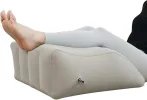
Thank you all. I live in England and the Lounge Doctor has to come from the US at more than two and a half times the price. Here is what I used for my first two operations. It is about 10 inches high at the top. What the
NHS nurse wanted was for me to use this as a base plus two further cushions which straightened out the bend and increased the height to 20 inches. That caused pain. What if I used this plus maybe one cushion with the bend as illustrated?


519mnGkMD9L._AC_UL640_QL65_.webp
NHS 519mnGkMD9L._AC_UL640_QL65_.webp
 
Try it. I don't think it will hurt to try it, or just try it without an extra pillow (s)

It is our lymph system that rids the body of fluid (swelling). So you want to get the fluid to the lymph nodes in your torso area so your body can more quickly process it. The lymph system works rather slowly on its own and much more efficiently with the assistance of gravity. The fluid isn’t draining into the hips, but contained with the lymph system and moving to the torso and lymph nodes located there.
Experiment a little and let us know what you think, Rosa. :thumb:
 
Here is what I used for my first two operations. It is about 10 inches high at the top. What the
NHS nurse wanted was for me to use this as a base plus two further cushions
That seems way to high to me.
The bottom line is if hurts don't do it. Your body knows what's suits you best.
I didn't anything that high.
 
You’ll find a lot of doctors and therapists recommend elevating with a straight leg. The idea is that it helps you get proper extension, which can be the most difficult goal to reach in recovery. But there are just as many medical professionals that agree with us that a slight bend in your knee is more productive and comfortable. You can do separate exercises if you’re working on extension, but our members support our recommendation of elevating toes above the nose with a slight bend to your knee. The inflatable pillow you posted looks very much like Lounge Doctor’s inflatable version and it’s fine. I did notice in the photo, the person using it was sitting up. That’s not the best position. You should have your torso flat or nearly flat to achieve the correct elevation of your leg above your heart.
 
Hi Rosadogrose, :wave:
Its been almost two months since we've heard from you. How are you doing at 2.5 months post TKR revision?
I hope things are moving along for you and you're noticing improvements in strength, stamina, flexibility and comfort lately. Please let us know about your progress when you have time. We'd love to hear from you!
@Rosadogrose
 
Hi Layla

Thanks for thinking of me. I am delighted to report that I'm doing really well. Most of the time I'm walking unassisted, I'm swimming again and gardening and driving and going to the grocery store. Planning a trip for next year.

I have some stiffness still, but nothing to write home about and much of the time I'm not thinking about my knee. That is such a change from how it was before this third operation: I used to dread every step and planned my routes for efficiency's sake, so I had to walk as little as possible. Just starting this week I'm not thinking about my knee getting tired - it is fine as long as I need it to be (not taking any hikes yet or running marathons, however). I can't tell you how wonderful it is to contemplate a pretty normal future for my age, and to enjoy sweeping a floor without thinking about my knee.

I had my ten week physio check up this week and my ROM is 0/120. If I wanted I could join an NHS TKR class but the physio said I was really 'too advanced.' It's been a long time since anyone said anything like that to me.

So, touch all kinds of wood, it was in my case third time lucky. Thank you all for all your help.

Just to say for information I had a revision TKR with hinge on January 26th after two previous operations that didn't go well - my MCL was damaged.
 
It's our pleasure to check up on you and read about how well you're doing!
It's wonderful to read that your knee is no longer in the forefront of your mind and you're going through the motions of daily living without giving thought to your knee, or how it will be affected by your actions. That's great news! "Too advanced" that you don't need physio...music to your ears! That's wonderful reassurance that you're doing exceptionally well. I do hope you'll keep in touch over then next several months, because I'm certain the news will only get better! Happy Spring! :flwrysmile:
@Rosadogrose
 
Great to read your post as I await a revision TKR. I need some good stories to help me along this journey as I too live alone. Thank you and well done.
 

Staff online

  • djklaugh
    Staff member since December 30, 2020

Members online

Back
Top Bottom