

 United States
@burbn8r this was encouraging to me...
Stiffness After TKR: How to Avoid Repeat Surgery
Edwin P. Su, MD; Sherwin L. Su, MD; Alejandro Gonzalez Della Valle, MD
Arthrofibrosis
Despite a surgeon’s best efforts and surgical prowess, some patients will continue to develop frustrating stiffness post-TKR. There is likely a genetic component of scar tissue formation that has yet to be identified. These patients will, no matter what, continue to develop arthrofibrosis as part of their healing process, despite flawless technical execution of their TKR.
Treatment Options
In any patient at risk for stiffness (ie, the multiply operated knee, the hyperflexible, and the patient with a prior history of stiffness), close follow-up should be performed. As the treatment options diminish with the chronicity of the condition, these at-risk patients should be seen sooner after TKR. Whereas in general, we see patients 6 weeks after TKR, we will see the at-risk patient at 3 to 4 weeks postoperatively. A trajectory of their motion gains can be ascertained at an early date, potentially preparing the patient for an intervention.
Manipulation Under Anesthesia
Manipulation under anesthesia is the first tool in the armamentarium of dealing with postoperative TKR stiffness. It can be effective in managing limited flexion; however, it is less successful in addressing a flexion contracture.
The literature indicates that manipulation under anesthesia is successful in the treatment of 80% of cases of post-TKR stiffness; however 20% will require repeat manipulation, and 10% will ultimately undergo surgery for stiffness.2
The complications of manipulation under anesthesia include periprosthetic fracture and extensor mechanism disruption; the likelihood of these complications is more likely as the chronicity of the condition increases. Therefore most surgeons advocate manipulation under anesthesia within 3 months of TKR to optimize the risk/benefit ratio.
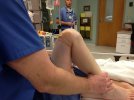
We perform manipulation under anesthesia with the use of an epidural catheter. Gentle, controlled pressure is placed on the tibia close to the joint line, to mitigate the risk of tibial fracture. The breakage of intra-articular adhesions can be palpated and heard; the manipulation is performed until there is no further breakage of scar tissue, which usually requires a few attempts. Manipulation for an extension deficit is more difficult and less controlled; the risk of supracondylar femur fracture is too great with the application of excessive force.
Initiation of intensive physical therapy is important to lock in the gains of the manipulation under anesthesia. We have also found that pictures of the achieved ROM are a good motivating factor for the patient and therapist, giving them a goal to work toward.
Admin note: Emphasis on information in the paragraph above is from the poster and not in the original article.
Stiffness After TKR: How to Avoid Repeat Surgery
Edwin P. Su, MD; Sherwin L. Su, MD; Alejandro Gonzalez Della Valle, MD
- Orthopedics
- September 2010 - Volume 33 · Issue 9.
Arthrofibrosis
Despite a surgeon’s best efforts and surgical prowess, some patients will continue to develop frustrating stiffness post-TKR. There is likely a genetic component of scar tissue formation that has yet to be identified. These patients will, no matter what, continue to develop arthrofibrosis as part of their healing process, despite flawless technical execution of their TKR.
Treatment Options
In any patient at risk for stiffness (ie, the multiply operated knee, the hyperflexible, and the patient with a prior history of stiffness), close follow-up should be performed. As the treatment options diminish with the chronicity of the condition, these at-risk patients should be seen sooner after TKR. Whereas in general, we see patients 6 weeks after TKR, we will see the at-risk patient at 3 to 4 weeks postoperatively. A trajectory of their motion gains can be ascertained at an early date, potentially preparing the patient for an intervention.
Manipulation Under Anesthesia
Manipulation under anesthesia is the first tool in the armamentarium of dealing with postoperative TKR stiffness. It can be effective in managing limited flexion; however, it is less successful in addressing a flexion contracture.
The literature indicates that manipulation under anesthesia is successful in the treatment of 80% of cases of post-TKR stiffness; however 20% will require repeat manipulation, and 10% will ultimately undergo surgery for stiffness.2
The complications of manipulation under anesthesia include periprosthetic fracture and extensor mechanism disruption; the likelihood of these complications is more likely as the chronicity of the condition increases. Therefore most surgeons advocate manipulation under anesthesia within 3 months of TKR to optimize the risk/benefit ratio.
We perform manipulation under anesthesia with the use of an epidural catheter. Gentle, controlled pressure is placed on the tibia close to the joint line, to mitigate the risk of tibial fracture. The breakage of intra-articular adhesions can be palpated and heard; the manipulation is performed until there is no further breakage of scar tissue, which usually requires a few attempts. Manipulation for an extension deficit is more difficult and less controlled; the risk of supracondylar femur fracture is too great with the application of excessive force.
Initiation of intensive physical therapy is important to lock in the gains of the manipulation under anesthesia. We have also found that pictures of the achieved ROM are a good motivating factor for the patient and therapist, giving them a goal to work toward.
Admin note: Emphasis on information in the paragraph above is from the poster and not in the original article.
Last edited by a moderator:



 I hope it continues on for you.


 bfmasmommy