Guest viewing is limited

Knee Infection 4 years out please help

Hi @1fish2fish I have had Kaiser for 40 years, by choice, and have not had the problems you're having. Maybe it's the particular hospital, I don't know. But I do know you have options. I've never had to beg for a referral, I just ask my primary and she refers me where I need to go, unless she beats me to it and sends a referral. I then get a call the next day from a scheduler and an appointment is made.

I did notice recently that they did a referral by email when I needed to see a dermatologist and I easily made that appointment online. The way Kaiser works is you have a primary doctor of your choice who sees you for general stuff, and refers you to specialists when needed. After you see a doctor one time, your online appointment area is updated to allow you to make appointments online with many of your doctors, unless the particular doctor has an assistant you call to schedule appointments. If you don't have a primary, that may be the problem.

I've always seen my OS, never a NP, so that confuses me also. Sometimes after surgery, my regular OS will see me day one, then his PA may come in the next day, and after I go home I may see his PA the first appointment to remove stitches, but then see my OS for the surgery follow-up. (The PA is present during the surgery, but doesn't do any of it, and knows you and your case) Some doctors always do all their own follow-up for everything, it just depends on the doctor and your case.

Kaiser has a protocol they follow to make it easy to be seen and get care, you just need to learn their ways. Are they perfect? No. No system is perfect. Kaiser does a really good job and is always looking to improve and make the best care possible for their patients. I have been with friends who have different insurances who have to wait eons for insurance companies staffed by bureaucrats who decide whether or not to okay the treatment your doctor orders. And I have seen them get turned down over and over for care because some insurance office worker decides it's not needed or "covered". Kaiser doctors make their own decisions and don't have to wait for an okay by someone with no medical degree.

There is a place to call to get help and they will tell you how Kaiser works, they will also help you get something resolved if need be. It used to be called patient assistance, but it has a different name now and I forget the name. But you should find the number on their website. Their overall wait times to be seen are really very short, although if you happen to choose a very popular, well-loved doctor who is in high demand (like my OS) your wait times will be longer.

I also never have to wait for more than a few minutes in the ER, the system they have is so organized and efficient that the waiting room is almost always empty. They have a lot of staff and rooms in the ER to see patients, and they get you through triage and into a room within minutes where you see a nurse right away and a doctor comes in in a very (within 5 minutes or so) short while. Last time I was in the ER, I was taken straight in and already had about 6 nurses and doctors in my room waiting to treat me instantly as I was having a reaction to a medicine and was short of breath as a result.

I also love that all my records are right there on the computer so they can see every medicine or treatment, etc, instead of having records scattered around with other doctors, hospitals, etc. and have to hope you remember everything. My husband has a choice of basically every insurance available in California and we choose Kaiser, and have for 40 years. I hope you familiarize yourself with them and get well soon!
 
Last edited by a moderator:
@lovetocookandsew, I split your post up into paragraphs so it's easier to read.
Please don't make posts that are one huge solid block of text! Yours was actually nearly 700 words! :swoon:
 
1fish2fish, I sure hope you are doing better. My MRSA this last time did not show up with the aspiration of the knee, cultures, blood tests, MRI, or anything. I was running a small fever, had a very red and swollen knee. When the surgeon opened me up he really found a boat load of MRSA in four areas.

They tried to have me go off antibiotics for 2 weeks before the surgery. They were thinking they were suppressing the MRSA from being cultured. The fever got out of control by the 7th day. It went up to 104, and right after the surgery too. On the 9th I had emergency/urgent surgery. The MRSA was very bad. I do not remember the 3 days after the surgery. That doctor and my ID doctor literally saved my life.

I have had the antibiotic spacer and rod in since Feb. 17th. The infectious disease doctor made sure the ortho doctor got all the cement out when he took out the apparatus. I am looking forward to April 7 when I see my ortho. They have been looking closely at all my blood work which they take every week. The white blood cell count has gone down, and there is one test in particular (can't remember) they are always looking at. My blood tests are doing great right now. However, my PT told me about one of his clients who after 15 years had MRSA show up. I hope to take antibiotics forever!
 
Last edited by a moderator:
I wonder if more docs are using Dr. Maale's method of putting antibiotic beads in the cement.
 
Actually, using cement impregnated with gentamycin has been the standard for all joint replacements for many years - decades, even. Garramycin beads are designed to be implanted in inside infected bone.
The infectious disease doctor made sure the ortho doctor got all the cement out when he took out the apparatus.
Really, he shouldn't have need the ID doctor to tell him that. It's an absolutely vital part of the treatment. I've spent many 'happy' hours scrubbed for PPIs chipping every vestige of cement out of hip. It's a lot more complicated in a hip, down the femoral shaft, as the inside can't be seen much less access. All sorts of tools have been devised - a lamp on the end of a long fibre, and our favourite, OSCAR (Orthopaedic Cement Removal System) which knocked the fragments of cement out with ultrasound waves. So you can see why this comment surprises me!

[Bonesmart.org] 4 years out please help


my PT told me about one of his clients who after 15 years had MRSA show up
Yes, I'm afraid we are all at risk for almost all our lives but happily it's a very small risk!
 
Thank you all !!! So the fluid they drained out of my knee, grew nothing phew! Now they are finally doing a bone scan to see if the implant is coming loose.
The surgeon said he sees halos in my x-ray so worth checking out. I'm walking without crutches, not gracefully but walking, seems taking the fluid out helped. The fluid was yellow and bloody, so glad it's wasn't infection, but still don't know what.
I'm going to try and post x-ray showing halo around implant.
Referee54 may be able to tell.
Thank you all for your support.
Upload says file to big maybe someone could help me figure out how to post x-ray?
 
I am so sorry to hear what you are going through. Although I'm only 10 months out, the thought of infection is something I know can happen at any time. The fact that it has taken such a long time to get the necessary care is a crime. Your continued advocacy for yourself is the only thing that will work. I had terrible treatment from the rehabilitation center where I went after surgery. I filed a grievance with my insurance company so another patient would not suffer as I did. Even in my fog, I kept notes, took pictures with my phone, amd had that evidence to accompany my report. The outcome was that the entire staff needed to be retrained and the center is subject to unannounced visits from professionals. Keep notes, let the medical team know you are in charge, they work for you! As patients we must not be frightened to advocate for ourselves. We don't need to be adversarial, yet calm and direct in our requests. I send you healing thoughts.
 
The femoral implant looks secure but the tibial one has a significant space in the cement-bone interface which denotes loosening. There is also, in my opinion, a poor distribution of bone cement around the tibial implant. Compare it with mine - the fluffy cloud looking stuff around the stem is the bone cement

[Bonesmart.org] 4 years out please help
 
So Uggg! I will be getting bone scan soon guess then will know for sure how bad it is.
Will have to find out what they do about it, it my explain the bone pain I feel in tibial bone, sometimes feels like it's fractured.
I will post results
Thank you!
 
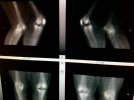
Bone scan today looks like knee cap problem?? What do you think Josephine?
 

Attachments

  • [Bonesmart.org] 4 years out please help
    20160425_132052-800x600.jpg
    33.1 KB · Views: 184
I can't tell, I'm afraid. Those images are not of diagnostic quality being too small and being taken at an angle.
Besides which, I was never trained to interpret MRI/CT scans,only xrays - sorry.
 
I was told that the bright areas are of concern and my knee cap is very bright!
I will let you know what the orthopedic surgeon says.
Thanks again
 
I hope you get to see your OS soon so you can then know exactly what the problems are and how to fix it.
 

Members online

No members online now.
Back
Top Bottom