I'm afraid your not going to like this answer. Your 26 days into a long recovery. Your knee is healing and most likely swollen. Those two add up to less ROM. Any swelling, internally or externally will affect your ROM.
You said your icing & elevating. Are you elevating properly? That is key, the knee needs to be above your heart. What exercises are you doing? They might be too much. Frankly at this stage of healing all you need to be doing is resting, elevating and ADL. (Activities of Daily living.) Meaning small walks around your house. It could be that your doing more than your even aware. I'd cut back on everything and not do the exercises for several days and see how you do. Your ROM won't happen quickly, and will more than likely continue to get better well into recovery year two.
I certainly don't mean to disappoint you but your where your knee needs to be. Your not at where you want to be. Prior to surgery did you have a good ROM? Take a deep breath and let your baby knee do some more healing then ever so slowly add activities.
Here is some information on elevation.
Proper elevation is one of the best ways to help with pain and swelling following either hip or knee surgery. Many people elevate improperly, which can dramatically lower the effectiveness. In the weeks following your surgery, make sure you elevate your legs as much as possible. Pay close attention to the images below to avoid the wrong way (red "x") and ensure the right way (green check mark) to elevate.
Should you choose to use a foam wedge for elevation, we've provided links to an information/purchase page for the Lounge Doctor on images below. Your purchase through this link gives you a quality product we proudly support and provides a donation to BoneSmart.
When you are relaxing and elevating your legs, it's not enough to just put your foot on a foot stool like these
and the leg flap on some recliners only comes up to about 30 or 40 degrees before the back rest starts to go down. Many recliners also keep the feet below seat level even with the chair reclined. You're not getting proper elevation in any of these situations.
For a
KNEE REPLACEMENT, it's also not a good idea to try and elevate with your leg totally straight like this as it stresses the muscles at the back of your knee tremendously, which can cause pain instead of helping it.
You may hear that you should try to keep your legs straight when elevating in order to help with your leg extension. But when you have a swollen, painful leg already, this is not helpful and can be quite uncomfortable, if not torture! A slight bend at your knee is much better for both you and your new knee.

Click photo for more information
on the Lounge Doctor
Don't EVER use a wedge that keeps your knee bent, either - like this. It really is a
as it puts pressure on the wrong places in your leg.
The correct way to elevate
At a minimum, your foot should be above the hip and the higher the better in order to get good drainage for the lymph and tissue fluid that is the primary cause of swelling. This also helps with the pain levels.
An often quoted is "toes above nose" gets the point across very well, although this more appropriate in cases of extreme swelling.
Here are some points to remember when elevating:
- If you are a
hip patient, observe the 90 degree rule if required by your surgeon.
- If you are a
knee patient, never have a bundle of pillows or a cushion firmly behind the knee or belly of the calf as shown in these six photos below. All these positions cause compression in the knee and calf which may result in a blood clot, especially in the early days post-op.
- Other dangers that can arise if a pad or cushion is placed under the knee include:
Compartment syndrome
Lymphoedema
Thrombosis
- Make sure your heels are not in a position to take weight or pressure as this can lead to sore heels and in extreme cases you may even risk getting pressure sores.
Some examples of good elevation:
1. In or on the bed
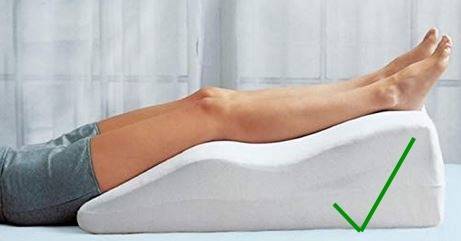
Click photo for more information on the Lounge Doctor
2. On the couch - though preferably not with your back twisted like this lady's is.
Click photo for more information on the Lounge Doctor
3. Sitting up on a chair. Be sure to have a high back to support the spine, neck, and head.
4. Using a pillow stack.
A pillow stack can often fall apart, so one of our BoneSmarties suggested using three inexpensive pillows and giant safety pins (available on Amazon) to create a pillow wedge. This can be a good alternative if you choose not to purchase a foam wedge.



 United States


 literally use it for 45 minutes several times a day, icing the front, back and sides, do as eaglemom suggested elevate this helps reduce the swelling and importantly cut back on any extra exercises that you are doing.

 “
“ “
“