

You are using an out of date browser. It may not display this or other websites correctly.
You should upgrade or use an alternative browser.
You should upgrade or use an alternative browser.
THR Rick's Recovery Thread - Now A View from the Clouds (literally)!
- Thread starter Rick02809
- Start date
- Status
- Not open for further replies.


Re: Out of work question?
Hey rick - im 38 too and had a complicated right THR 6th feb (im in week 5 post op) posterior approach.
I had my follow up with OS on monday and had all my restrictions lifted - that said i am still walking with one crutch and am in no way ready to drive or use public transport to travel to work.
I plan on returning to work next week for a couple of days a week, 10-4ish. they are providing a taxi to get me there and back. I have a desk job and can take breaks to walk (hobble about). I have been working from home on the sofa on a laptop now a few hours a day for two weeks.
I do not expect to be working full time again and getting there under my own stem until at least week 10.
You must do what feels right for you. you know your body. I think it would be very exceptional for you to feel ready to return to work before 6 weeks and even then only part time probably.
Most of all I dont think there's any point speculating till you've had the surgery and know how you are healing
best wishes
Erushka
junior member
Re: Out of work question?
Rick, congratulations on your impending return to work! It's a major milestone, but you sound confident. That's half the fight.
I lived in Providence for 7 years. Nice town. Really enjoyed going up to Federal Hill and visiting the Italian restaurants.
I have worked as a rehabilitation counselor for 23 years. Basically, I help people with disabilities return to work. These days most of my clients have mental health issues, but I have worked with lots of physically challenged folks as well. I'm sure that I've worked with 3000+ clients over the years.
So, I have some ideas about return to work, based on professional experience plus my own adventures as a fairly new hippie. I hope some of these ideas will be useful.
First, read Josephine's article on a phased return to work. She is absolutely spot on.
Second, work is inherently stressful. A stress is any stimulus that evokes a response. Your bedside alarm going off is a stress. Your partner asking, "Honey could you please..." is a stress. Work is full of stresses all day long. You are required to produce something, to reach certain goals. Usually this happens on the employer's schedule, not your own. People demand things of you. You may have to deal with people who you really don't like. You certainly will have to do some things that you don't like, and you will have to tolerate some level of boredom. At times you cannot take a break no matter how you feel. I could go on and on, but the point is that work for someone else, even pleasant satisfying work, is stressful. It is much much more stressful than recovering at home.
Everyone has a level of stress that he or she can tolerate. This is a very individual matter, everyone is different. And, there are many different types of stresses--some of us tolerate certain types of stress better than others. Unpleasant things happen when our stress tolerance is exceeded. Symptoms such as fatigue, irritability, and anxiety are very common. They tell us that our stress tolerance is being tested.
We hippies have endured significant stress from our surgeries and rehab. Our stress tolerance is pretty low. We need to build it back up in order to work successfully. So here are some suggestions as to how that can be done.
As I mentioned, start back part time. If that is tolerable, add more hours.
Talk with your boss before your return. Make sure that any needed accommodations are in place. Do you need frequent walking breaks? A raised toilet seat? Access to ice on demand? Temporary assignment to light duty (applies mostly to manual workers)? A variable work schedule? Just make sure that everything is in place before you return.
Make sure that you can have time off for any needed medical appointments. Try to schedule those appointments for off hours if possible.
If you can, work part time from home before returning to the workplace. You can comfortably improve your stress tolerance, and feel useful and productive at the same time.
Anticipate the possibility of setbacks, and plan for them. Just because you have returned to work, do not assume that your recovery is complete.
Finally, know your rights under the Americans With Disabilities Act (ADA) and the Family and Medical Leave Act (FMLA). Read up on these Acts, know your rights. Those who have chronic disabilities may benefit from services from their State Vocational Rehabilitation agencies (VR). VR can help with workplace accommodations, job counseling and placement, and a host of other challenges faced by those with chronic or permanent disability.
I hope that this has not been too technical, but it seemed like a good opportunity to chime in. My OS told me that I'd be back to work in 4-6 weeks. I'm now about 7 weeks out from surgery and still working on several issues that are keeping me from work. But I will get there, and so will you. Peace.
DallasSarah
post-grad
- Joined
- Oct 26, 2011
- Messages
- 1,248
- Age
- 60
- Gender
- Female
- Country
 United States
Re: Out of work question?
Hey Rick,
Thats a great update congratulations! I'm happy you wrote about the part about why did you wait. I feel exactly the same way. I LOVE my new hip
Poor baby yes I'm sure your dog will miss you. My friends always tell me dogs do adjust in routines, its still makes me go awwwwwwwwww!!
All the best,
Sarah
OP
OP

Rick02809
junior member
View from the clouds (literally)
Well, it's been 4 months since I had my RTHR, and I can say that I've been busy post op. I went back to work at 8 weeks instead of 12; PT is all wrapped up and my OS told me that he wants to see me in a year.
I am back volunteering on the ambulance twice a week at night and also back on the Ladder truck as well. Si
nce my surgery, I've been feeling myself getting stronger; although, I find myself achy and tired at times. There are days in which I feel wonderful, and those are the days that I tend to I over do it. The next day, I pay for it.
A few weeks ago, I helped fight a brush fire, lugging tools around, mostly feeding water to brush trucks, after 3 hours of that I was done.
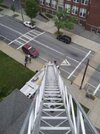
Last week I had the opportunity to make my goal, climb "the stick", a 110 foot aerial ladder. I got an e-mail from my Deputy Chief asking if I could help remove a damaged weather vane from the local courthouse. I told him, SIGN ME UP!
Well, here is our attempt at removing the 4 foot tall vane, the spire is 60 feet off of the ground, I climbed the 93 feet up the ladder and assisted the chief, it was a great feeling knowing that I can do *almost* anything that I used to.
By the way, in the photo the maroon car is a full sized GMC Suburban to give you a perspective, and the guy at the top of the ladder (Chief DeMello) is 6'3" and 250 lbs, a big guy.
For those of you on the fence about getting a new hip, Listen, with determination and perseverance you can accomplish anything that you want to.:yes 4:
Attachments

Wilsomasan
junior member
Re: View from the clouds (literally)
Holy cow! You are my new hero! Good on ya!!
Holy cow! You are my new hero! Good on ya!!

How exciting, Rick!!!! It's so good to hear how well you're doing!
You will notice that I have merged all your recovery threads into this single thread. We like to keep each member's updates, questions and concerns in a single thread. That way it really tells your story - much like a blog. I created a title for you, but if you prefer something else, just post what you want here and one of the staff will get it changed for you!
I hope you come back now and then with more photos of what is going in your life! We absolutely LOVE success stories! @Rick02809:

OP
OP
Rick02809
junior member
Jamie:
I am impressed with the changes, it is a lot easier to follow the recovery stories now, thanks for all of your help!
I am impressed with the changes, it is a lot easier to follow the recovery stories now, thanks for all of your help!

Excellent up date, Rick! I agree with Wilsomasan - you're my new hero. LOL I thought I was doing well to climb my 3 step step-stool :th_heehee:
- Status
- Not open for further replies.