Guest viewing is limited

Revision THR Continuing thigh pain from failed osteointegration?<

I didn't think you were whining, but if you were...
Whining IS allowed!:sorry:
I was the consummate whiner, and I haven't had near a frustrating time as you have experienced!
Keep the faith!:yes:
 
Last edited:
Hi @TerryB_TX
Best of luck as you begin your appointments today.
I hope all runs smoothly for you.
Wishing you comfort and peace.
 
Well, my first appointment with a revision specialist did not go as I expected. New X-rays were taken, A/P, Standing – x-rays appeared to my eye a bit fuzzy, so more difficult to see space between bone and femoral stem. Implants appeared to doctor to be “ok and fixed”, perhaps some fibrous fixation on lateral side of stem, but he felt there was adequate bone integration.

We discussed the three different types of pain I've been experiencing. The thigh pain, described as “start-up” pain (after rising from lying or sitting position), that calms down with walking, was attributed to IT band tightness. The groin pain was attributed to Psoas muscle/tendon tightness. He explained that both of these have a common root cause of having introduced with the prosthetic stem some additional offset of the femur , essentially displacing the femur laterally relative to pre-operative leg, stretching and tightening the IT band and Psoas muscle.

Deep buttock pain on operative side was attributed, at least in part, to a congenital deformity of the pelvis/spine. X-ray appears to show some sort of boney structure from the crest of right (non-operative side) ilium extending to the vertebrae. It's not present on the left (operative) side. I got the impression that it was the right side that had the unusual feature even though the gluteal pain is on my left. Scratching my head now, but didn't have the presence of mind to pursue the apparent contradiction during our conversation at the time. I've attached an earlier x-ray with the structure he was indicating encircled. Maybe @Josephine would have some insight?

Treatment options discussed...
  • Psoas/IT band tightness should first be addressed through strengthening/stretching/massage of affected areas – got prescription for PT (2-3x/week for 6 weeks)
  • Psoas tightness may also be addressed through surgical release of psoas tendon. Described as series of small “nicks” to tendon/muscle until sufficient slack is achieved. This can be done open surgery or arthroscopically, but he does not do arthroscopic psoas release. Not recommended at this time.
  • Additional offset could be reduced through revision surgery but would involve difficult removal of fixed femoral stem (likened to pulling the sword “Excalibur” from the stone!) – not recommended.
Finally, he recommended I see a spine specialist to discuss back/spine issues. The nurse also mentioned that the revision surgeon at one time shared a practice with original THR surgeon.

Next opinions scheduled for Monday and Tuesday. Will update with results of that conversation next week.

[Bonesmart.org] Continuing thigh pain from failed osteointegration?<
 
Interesting that he agrees with me in most aspects!
 
@TerryB_TX I have just read the results of your dr.'s visit, and am trying to square what @Josephine said a number of posts earlier--which was that the stem looked loose to her--with what the surgeon said today, that "perhaps some fibrous fixation on lateral side of stem, but... there was adequate bone integration". If it is like removing Excalibur from the stone, it sounds like he thinks then the stem is sufficiently rooted and grown into the femur, which would be good news perhaps so far as not needing a revision, perhaps? Josephine at least observed it looks loose to her, and your original surgeon also said it was held in part by fibrous tissue with failure of the bone to integrate, which would also imply at least an element of looseness? Not sure if other bone scanning techniques might be useful to see more of what is going on in there either. Is the revision surgeon saying it is possibly slightly loose in that one area and that this is OK? Or, in layman's terms, is "slightly loose" as bad as "loose" with implants? Has he ever seen this before and what was the outcome of his suggested treatments?

I am not a doctor so don't understand how your deep buttock pain on your operated side is affected by the congenital issue on the other side?? I am sure you will discuss this with the other revision specialists, but that one is a head scratcher.

I also wanted to volunteer that I had many months of massage therapy and stretching on my operated thigh and psoas (for groin pain), as well as my piriformis (deep pain in middle of buttock). I was thinking that muscle/tendon issues were my problem as my psoas were incredibly painful at the time (and could very well still be, for all I know), and my piriformis on both sides have also always been tight and painful, actually unrelated to hip surgery. I definitely believe in the benefits of massage therapy, and was hopeful this would cure me. This time around, I would leave the massage room feeling like quite tight muscles had been released, my groin, leg and butt would feel so much better, but then a few days later, the pain(s) would come right back. This went on for many months, almost a year. That is not to say at all that my issues have any similarity to your issues, of course, and I am not trying to make an analogy here, just reporting on my experiences. At that point, I had not yet had the rifle shot pains in my thigh that I got last fall, which then prompted me to see my original surgeon.

I also have always had very tight IT bands and have used a Tiger Tail for years to roll them -- painful, but if I did this regularly it would cause the IT Bands to hurt much less. Regular massage also has historically helped loosen up my IT Bands, or at least make them less painful. (It's interesting, I never had any "start up pain" as a result of these tight IT bands before my hip replacement, BTW. How is your IT band on the non-operated leg? I have no start up pain whatsoever in my non operated leg as a result of a tight IT band. But perhaps none of this is relevant, most especially if he is stating your femur was moved a bit to the side as a result of the implant surgery, and therefore is stretching out or impacting the psoas and IT bands.)

Lastly I have arthritis in my lower spine and have had radio frequency ablation, which was very effective but requires a skilled physiatrist to perform. This was done before my hip replacement. It is about 6 years later, and some of the nerves have regrown and do cause some lower back pain, which was neither helped nor hurt by my implant.

It looks like you will have many more questions than you planned for the other surgeons for sure. So sorry you are going through all of this. I might ask Josephine to clarify her comment above; so, is he saying that there is one area on your stem where there is (only?) fibrous attachment, and that this is tolerable and OK, in that it would not/does not destabilize your femoral stem? Is there ever such a thing as "a little bit loose but OK"? or an area with little to no integration with the bone being "OK", if the rest of the stem is firm and sound? Would she recommend other types of scans to see better what is going on in there?

Not sure if this is either helpful or relevant but in case it is, I thought I would communicate some of my thoughts and experiences with you.
 
@Chalcedonnian . From what my original THR OS said about fibrous fixation of the stem, and my understanding that fibrous fixation equated to a loose stem, I was totally unprepared for the revision surgeon's conclusion that the stem was "ok and fixed" and needed no revision to address a loose stem.

The original THR OS stated in my 1-year follow-up that the stem was "held in place by scar tissue" and that this occurs in about 1% of his patients. He suggested I not play the lottery. I found that as funny as you found the "upside down" stem comment from your revision consult. I have since received copies of the 1-yr follow-up notes from my original THR OS. Quoting from his notes, "both the femoral and acetabular components are well seated... fibrous scar tissue fixation along femoral stem w/o migration...only very mild subsidence of femoral stem...mild acetabular cup protrusion that could be irritating psoas tendon."

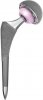
I understood a loose stem to be a loose stem, that there was no such thing as a partially or slightly loose stem. Perhaps it is not uncommon to have only a partially bone-fixated stem? That just doesn't seem very secure to me, but maybe it's good enough. I did press the revision OS a bit on fibrous fixation and he discussed how there are different surfaces on the stem (a Depuy Pinnacle), and that only the upper portion is textured to encourage ingrowth of bone, but not on the entire stem. In fact, I can see that on the picture I pulled off their website (attached). He also discussed how the medial side of the implant was in compression, while the lateral side was in tension with the bone. I interpreted that as suggesting that perhaps the medial side could be fixated better than the lateral side of the implant, though he never explicitly stated that. Anyway, he seemed convinced that a loose stem was not my problem. I'd love for @Josephine to weigh in.

I'm not going to get my hopes up yet. I've got two more appointments with revision surgeons next week so perhaps I'll get more clarity then. Right now I'm just more confused than ever. If a revision for loose stem is ultimately needed, I'm concerned about femur damage given his Excalibur comment. I'll try not to worry about that until or unless I have to.

Like you, I also did months of massage therapy for IT Band and Psoas tightness. I had the same experience as you. I felt better after the session, but it lasted for only a few days. I also continue to do psoas stretches on my own and I regularly rolled my IT band with a foam log roller. Once I believed I had a loose stem, I stopped the rolling because I was concerned I might do damage with that kind of pressure on the femur (I could feel some discomfort at my hip joint). I never had IT band tightness in either hip prior to THR surgery. I mentioned to the revision OS that I had massage therapy for the IT band and psoas muscle. He said that while massage is good, the strengthening and stretching is far more important.

I've had chronic lower back and hip muscle pain/tightness since before the THR. I used to manage it with daily stretches, but am doing much less of that now due to the continuing thigh pain. I'm likely to visit a spine specialist at some point, as recommended. I'll ask about the radio frequency ablation. Perhaps that will give longer term relief.

Thank you again for sharing your experiences and suggestions. It helps me tremendously. Wishing you continued healing and a successful outcome.
 

Attachments

  • [Bonesmart.org] Continuing thigh pain from failed osteointegration?<
    DePuy-PINNACLE-CoMplete-Ceramic-on-Metal.jpg
    7.3 KB · Views: 298
@TerryB_TX Hmmmm, it was also my understanding that a stem that is loose, no matter how much, needs to be revised, period. I have not heard of a "little-bit loose stem that is OK as-is". But I am not a medical professional and maybe this nuance is an important one in your case.

So is this revision OS stating that it is perfectly normal for "the lateral side to be in tension with the bone" given where the different surfaces on the stem are? I have not heard this before (though I did know about varying stem surfaces), so am interested in what it really means, layperson style.

Perhaps it would be helpful if you listed your newer questions for Josephine to answer, one by one. There is a lot of information to distill in your posts, but it might be easier for her to answer a solid list, just not sure.

So far as the Excalibur comment: my revision surgeon said to me that sometimes the femur does fracture during stem removal, and sometimes that is actually better for the revision (though I cannot remember why, and don't want to sound cavalier about this, I was concerned about how hard it would be to pull out the stem). Josephine posted some information on my older threads about one instrument that is used and how the removal procedure goes, which she said is harder on the surgeon than it would be on me, I would wake up and not know the difference! How does this revision surgeon know it will be like Excalibur from your x-rays? Does he have a lot of experience with revisions (do you know how many in the last couple of years he has done?). I am thinking of my own x-rays, where even I could see the stem shifting with a bone shelf under the tip of the stem, yet only 2 surgeons thought there might also be an issue with the cup in the same x-rays, but wouldn't know until they went in. (Josephine said she thought my cup was also loose from the x-rays I posted.) Well, my cup was plenty loose, my surgeon lifted it right out! Yet, 2 surgeons equivocated about whether or not it was loose in their opinions, which isn't a knock on them, I guess reading x-rays is a real art and science.

And I wonder whether there is any other kind of bone scan that would help "see" better what is going on with your implant.

I also wonder if yours is a case of first impression for these surgeons: e.g., they haven't really seen anything like your case before, or perhaps only a few times before, as it is "rare". Not a good time to be a rare bird, for sure, which is sort of how I felt until I met at least 2 surgeons who believed they had treated enough patients like me to predict what was going wrong. It must be frustrating, but I think your situation will become more clear the more you question surgeons, and hear their opinions. If all of them say they don't think your stem is loose, and other issues are creating the pain, obviously you will take a new approach. And if you did actually "connect" with this surgeon, you could always go back for another consult, that is certainly not unheard of, to ask further questions that piggyback on what he has already told you.

I hope and pray you get more clarity around this, the uncertainty and the various issues that may be combining to cause your problems/pains seem to be enough to make anyone just a little bit dazed.
 
@chalcedonian1 . I think I'll wait till I get my second and third consults before I tag Josephine. That way I can consolidate all the input and formulate a concise list of targeted questions for her. No sense wasting her time chasing down a bunch of possible rabbit holes while I'm still in the early stages of getting opinions.

This compression side / tension side business just seems like one of those dead-end rabbit holes. It seems counter-intuitive to me. I would think the most stable stem would be in compression on all sides while standing, distributing the weight as broadly and evenly as possible. I'm not sure what to make of his comments, but the concept of fibrous fixation on the lateral side was my inference, right or wrong. I don't believe he ever stated that specifically.

As you say, the key question from this consult is whether or not there can be fibrous fixation of the stem, in full or in part, and still have an acceptable stable and pain-free long term outcome. That's the question I'll add to my list for the next revision surgeons.

Thanks for your help in thinking this through with me.
 
@TerryB_TX Perfectly sound and logical reasoning! I hope you are able to have a nice weekend, and it will be interesting to see what the other surgeons have to say.
 
This compression side / tension side business just seems like one of those dead-end rabbit holes. I would think the most stable stem would be in compression on all sides while standing, distributing the weight as broadly and evenly as possible.
This is a technical issue with all implants including intramedullary rods. Let me see how I can explain it.

It happens to a curved item and when the stresses applied are different on one side to the other.

Compression is when an object is placed under force that squeezes it.
Tension is when there is a force which stretches it.
If there is another factor at play such as the oseointegration of bone in the hydroxyapatite, then it can affect whether the bone will get evenly applied to either side of it. Mostly it would be the compression side that would do well while the tension side would not.

[Bonesmart.org] Continuing thigh pain from failed osteointegration?<
 
I'm happy you have chalcedonian as you're navigating through.
All I feel capable of here is being a silent observer.
Will be watching your story unfold and remembering you in prayer. Both you and chalcedonian1
I hope you're able to enjoy the weekend!
@TerryB_TX
 
@Josephine, by your diagram I see that I misinterpreted the doctor's comments. I thought he was describing compression and tension between the bone and stem. Your diagram makes clear he was describing compression and tension within the stem. That makes more sense to me.

@Layla, appreciate your prayers and well wishes. I tend to take refuge in the more technical aspects of these emotional topics. At least it keeps the fear and anxiety at bay for a little while.

Good weekend to all!
 
I had my third revision surgeon consultation today. He confirmed @Josephine 's conclusion, and that of revision surgeon #2 seen the day before - loose stem requiring revision. That makes two out of three (plus Josephine) diagnosing a loose stem. Only the first revision surgeon felt the current stem was adequately fixed and all I needed was some PT. I left revision surgeon #3's office today feeling much more confidant and optimistic than I have in months. I think this surgeon sensed my appetite for technical details and spoke with me at length about the revision process, almost as a peer rather than a patient, in a clear, logical, and conversational style.

He said the stem was definitely loose , but felt that the cup looked well integrated and well positioned. For revisions, he prefers to use a "beefier" stem which would be longer and more cylindrical. His first choice would also be a stem that is textured and HA coated along on the entire surface, rather than the just the top half as is my current stem (he showed me a Corin stem example). This he described as his going-in plan, but the final choice would be made during the surgery. He will have the entire array of options available to him in the OR, including a cemented option, but he described this as a last resort and very unlikely. The option with which he ultimately proceeds would be governed by the quality of the fit he is able to achieve.

He noticed, as did surgeon #1, the additional lateral offset in my current stem. He would reduce this offset and said that should give me relief from the chronic and painful IT band tightness I've had since the THR. He felt the psoas irritation was most likely due to the loose stem rather than cup impingement. He would check for psoas tendon tightness, and if need be, he would do a surgical release during the revision surgery. (Revision surgeon #2 said he might need to remove the current cup and adjust the orientation to address the psoas irritation)

On July 25, I'll be having a needle aspiration procedure to take a fluid sample to be cultured for infection. He said infection is one of the possible causes of bone integration failure. Because I don't have obvious symptoms he thought it unlikely, but it needed to be done regardless.

Because this is a revision, I am to be non-weight bearing (toe touch) for 6 weeks post-op. Curious to hear what your orders were, @chalcedonian1. I believe you said you were going to clarify an apparent discrepancy between surgeon's orders and PT's initial approach.

This surgeon's practice is to prescribe Celebrex for 6 weeks post op. When I raised the issue, he acknowledged the debate but explained that HO is a different process than bone growth and stem integration inside of the bone, and that the data on the latter was inconclusive. I didn't press the issue, but unless there's a good reason for taking the Celebrex, I'm going to follow chalcedonian1's model and skip it once out of the hospital.

I still have a few questions I hope Josphine or others can answer, but I'll put them together in a separate short list later.

@Jamie , thank you so much for your help in providing me the list of revision surgeons. I don't know what I would have done without you. It would certainly have been a much longer, more stressful, and agonizing process on my own. I'll forward to you my feedback on each of the surgeons in a PM. Hopefully somebody else can benefit.

@Layla, I've been very apprehensive since I first recognized the possibility that a revision might be needed. I'm feeling a little better today now that I have a clear path forward. I know there will be many more ups and downs till the time comes that I am convinced that this revision is a success. I am always grateful for the kind encouragement and prayers from you and others on this site.
 
So glad you have some definitive answers.
Obviously I wish you didn't have to go through a revision but as you say, there is a path forward.
Need this thing fixed so you can get on with your life.
Wishing you all the best @TerryB_TX
 
I think many of us are watching your thread.
Revision, Infection.....words most of us fear and hope to never hear.
But many of you brave souls are forced to walk that path. My heart goes out
to each one of you. I will continue to watch your story evolve and keep you
in prayer for discernment, comfort and peace of mind as you journey through to perfect healing.
@TerryB_TX
 
@TerryB_TX Pretty much the same for me in terms of a longer and beefier stem. My first implant was a Corin, but the stem looks short compared to what I have now (and the first was the anterior approach, which supposedly is harder to use longer stems with, but don't know enough about that). I now have a longer, rounder more porous surface Stryker, with three screws from the cup, posterior/lateral approach.

So far as HA coating, my surgeon said that research has shown it doesn't make much of a difference. For awhile, the HA coating seemed just the ticket in the industry, but it hasn't turned out as anticipated (which coincides with my research too--and what Josephine reported to me; incidentally, my first stem was HA coated, and I also think coated with Vit. E), but it certainly shouldn't hurt to have it.

As I said somewhere in my thread, I was told by all 3 revision surgeons that they would not do a cemented implant, unless something very compelling and surprising was happening when they went in. My surgeon said to me the leg/hip are measured by software and same with the fit, along with the surgeon's eye and expertise. I was reassured about the LLD issue by him, this was a big deal to me, I don't want to be limping if I can help it; limping in recovery is one thing, but I would like to walk as normally as possible in the longer term (and the first surgeon gave me no such assurances, in fact, quite the opposite).

And of course from the xrays, my cup looked OK to 2 surgeons and possibly loose to 2 other surgeons. If the cup is OK, the question then becomes using a femoral stem etc. that fits perfectly with that already existing hardware--whether the same or a different manufacturer. I am sure your surgeon will check the cup during the surgery, and will take it from there. Surgeons like to use hardware they know well, and that is fine by me IF IT WORKS. FWIW, my surgery took only 2 hours.

I also had the needle aspiration just to rule out infection. I think some infections can remain silent but all my other numbers were so low, it was highly unlikely and indeed I did not have an infection.

I was to be partial weight bearing (50%) on 2 crutches for 2 weeks, then weight bearing as tolerated after surgery. I did discuss this the other day when my surgeon called to clarify, as there were two different sets of instructions from the hospital NP. He said that current research shows that what is more important than the weight bearing and restrictions is not to do any extreme motions or activities, that weight bearing even for the 50% usually devolves into weight bearing as tolerated. If it hurts, dial back, and absolutely no sudden movements or twists.

I had violated that twice inadvertently when I first came home, felt the pain and haven't twisted like that again. You get cured pretty quickly of doing things that hurt and conservative treatments and approaches seem to be better all in. I will go down to using one crutch once I feel a little more stable (but for me this is related to a torn rotator cuff that is getting irritated!). I am on a blood thinner for 4 weeks and am wearing compression socks for that period of time, they haven't been a bother at all. I have been walking two laps of my house every hour on the hour, and yesterday was a good day--it felt good and I really wanted to just move.

My surgeon prescribed Celebrex for 2 weeks only. But as you noted, I had to stop taking it anyway, as it turns out for the massive heartburn issue that would not go away--but I didn't see the need to take it, given the bone growth issue. The ice/cold water machine has kept swelling (and I guess inflammation) to a minimum, I think. I use it for hours every day, and have no knee swelling or other ill effects.

I am really quite sorry that you are going through all of this, but your visit to the first revision surgeon showed you that in a way it could truly be worse---all the pain you feel could actually still be a huge, frustrating puzzle to unravel if your stem was actually fixed properly.

That is what my hip seemed to me for the 2 plus years before I was told it was loose--I have never been so frustrated in purpose. Nothing I tried ever lasted for very long. Obviously, no one wants to be told they need a revision. But it seems like you tried a whole panoply of solutions to get better; it would be great if just 6 weeks of PT cured what ails you but to my untrained eye, it seems unlikely given all that you have done for yourself, along with Josephine's comments and the fact that 2 revision surgeons have said that your stem is loose.

All good lessons for anyone who needs a revision--go to a number of surgeons and LISTEN to what they opine, and ask a lot of questions because the first opinion you get might not be the prevailing opinions of the other surgeons. And as in my case, how surgeons read x-rays is also important!

So I guess what I am saying inelegantly is that needing a revision gives you something tangible to focus on, and some glimmer of hope that the elusive pains you have suffered actually might come to an end. I am still waiting for my full outcome, certainly so far, really good, and I know that having the revision was the right step--I couldn't go on as I had been doing. And I must say you sound very balanced about all of this, and way ahead of me in terms of your current mental preparation!

So I assume your next step is choosing the surgeon and the date. I took into account whether the hospital was a city or more suburban hospital. I personally avoid hospitals in the heart of a city if possible - lots of germs - but also don't want a very small hospital in case something goes wildly wrong). The MRSA rating of the institution, does the surgeon have two surgeries going on at the same time (yes, this happened right here in Boston at a major teaching hospital, it was very controversial, and now New England Baptist will actually tell you that its surgeons do only one surgery at a time, start to finish). Whether the surgeon is skilled in revisions (asking my doctor friends for inside info, numbers of revisions done in last 2 years, etc.), whether it is the revision surgeon who does the most important work of the surgery and not an intern. And lastly in my case, I had a choice to go to an orthopedic-only hospital (btw, I would never go to an orthopedic "clinic", have heard enough stories to not do that, but an ortho-only hospital is different).

I booked the surgery well in advance to get acclimated to the idea of having it and getting things in order. Looking back, it really would have been fine to have surgery somewhat earlier, but I am glad I got my work in order, as I am resting and recuperating with no guilty conscience at all. Once booked, time carries you forward, and I did not dwell on the surgery, just prepared for it, if that makes sense. I am pretty stoic and I dislike drama and did not tell my friends or work colleagues what was being done (only a couple of family members, and 1 friend who helps out with our pet). The last thing I wanted to do was repeat the story endlessly, and get needless sympathy which would actually only wear me down because most people are not on Bonesmart and really just do not understand why revisions become necessary. I did use this site for all my needs, and continue to do so, and have not been disappointed!

Let me know if there are any other questions you have, and I will be happy to answer to the best of my (very limited) ability. I can say that revision surgery is not the end of things or the worst thing I have been through, and in fact, I am still hopeful it is actually the beginning of regaining some of my life back. I will continue to ask questions here as needed. I have gotten through the first 2 weeks without a hitch, and hope it continues. I certainly hope the same for you!

 
@Josephine
Was hoping you might be able to answer a couple of quick questions for me...
  • Does the plan and comments of the third surgeon in my post above seem reasonable to you? Do you see any red flags in anything he's saying or planning?
  • He mentioned a choice of ceramic or plastic liner, and seemed to be offering me the opportunity to weigh in. He said the ceramic should be more durable, and that ceramic liners have been in use for 10+ years. Have you seen any reason to prefer one over the other? My preference is to go with the tried and true, I don't want to be a test subject.
I'm sure I'll have more later, but don't want to get too far ahead of myself.

Baring any red flags, I have made my choice of revision surgeon. It will be the one I saw yesterday (surgeon #3). I feel like everything he said made logical sense to me. He actually seemed to enjoy the opportunity to teach me about the procedure. It was clear he takes pride in what he does and how he does it.

@chalcedonian1, this surgeon also uses computer navigation to ensure proper fit and alignment. He did some leg length measures of his own (he thought THR leg ~5mm shorter), but he also documented my own personal impression of my LLD (I felt they were pretty even). I think he recognizes that everybody has naturally occurring LLD to some degree and one's body adapts and grows accustomed over time. The hospital he operates in is a large suburban hospital with a dedicated orthopedic surgery floor. I've still got a little research to do with respect to infection rates, etc, but feel confident his choice will be ok. My pain continues to worsen with time and so now all I want is to get back to my former self as soon as possible. You and all the contributors to your thread helped me recognize the inevitability of this revision and have enabled me to more quickly come to terms with that, mentally and emotionally. I know there will be setbacks and doubts along the way, but for now I'm feeling optimistic. This site and its community of users is such a blessing.

@Mojo333 , we started this journey on exactly the same date. You've already crossed the finish line. Hoping to join you there soon.
 
He felt the psoas irritation was most likely due to the loose stem rather than cup impingement.
I would agree with this 100%
This surgeon's practice is to prescribe Celebrex for 6 weeks post op. When I raised the issue, he acknowledged the debate but explained that HO is a different process than bone growth and stem integration inside of the bone, and that the data on the latter was inconclusive.
I don't agree. The mention of HO is simply enforcing the fact that NSAIDs can inhibit new bone growth. If it didn't, then why is it so effective for HO? Doesn't make sense!

to what they opine
chalcedonian, you are the only other person I have ever know use that word! It's one of my favourites!
So I guess what I am saying inelegantly
Not at all inelegantly! Quite the opposite in fact!
whether it is the revision surgeon who does the most important work of the surgery and not an intern
I have never, ever known anyone but the consultant do the whole of a revision surgery. The mere idea gives me the shudders!
 
Does the plan and comments of the third surgeon in my post above seem reasonable to you? Do you see any red flags in anything he's saying or planning?
Not really. All seems kosher to me!
He mentioned a choice of ceramic or plastic liner, and seemed to be offering me the opportunity to weigh in. He said the ceramic should be more durable, and that ceramic liners have been in use for 10+ years.
10+ years? And the rest! I'd say at least 25 years and probably longer.
Have you seen any reason to prefer one over the other?
Nope!
My preference is to go with the tried and true, I don't want to be a test subject.
What makes you think that either would make you a test subject? Just curious ...
 
. Hoping to join you there soon.
Oh my stars...I just noticed that in your signature.
I do so hope so too, Terry.
I also commend you for your quest to do due diligence for as much as we can to achieve the best outcome after all this distress after your initial surgery.
It actually embarrasses me that I, for alot of reasons but mostly naivety, did no such research and by Providence or sheer luck, was referred to a great surgeon with great results :fingersx: to date

You are going to have a little different path, I'm hoping in a few short years through healing and we are both golden!
Keep the faith!
 

Members online

No members online now.
Back
Top Bottom